Evil Hills — free browser survival horror on Venus
Station Hesper-4 has missed three reporting cycles. The Space Farming Agency sends one inspector, because one inspector is cheaper than two.
What it is
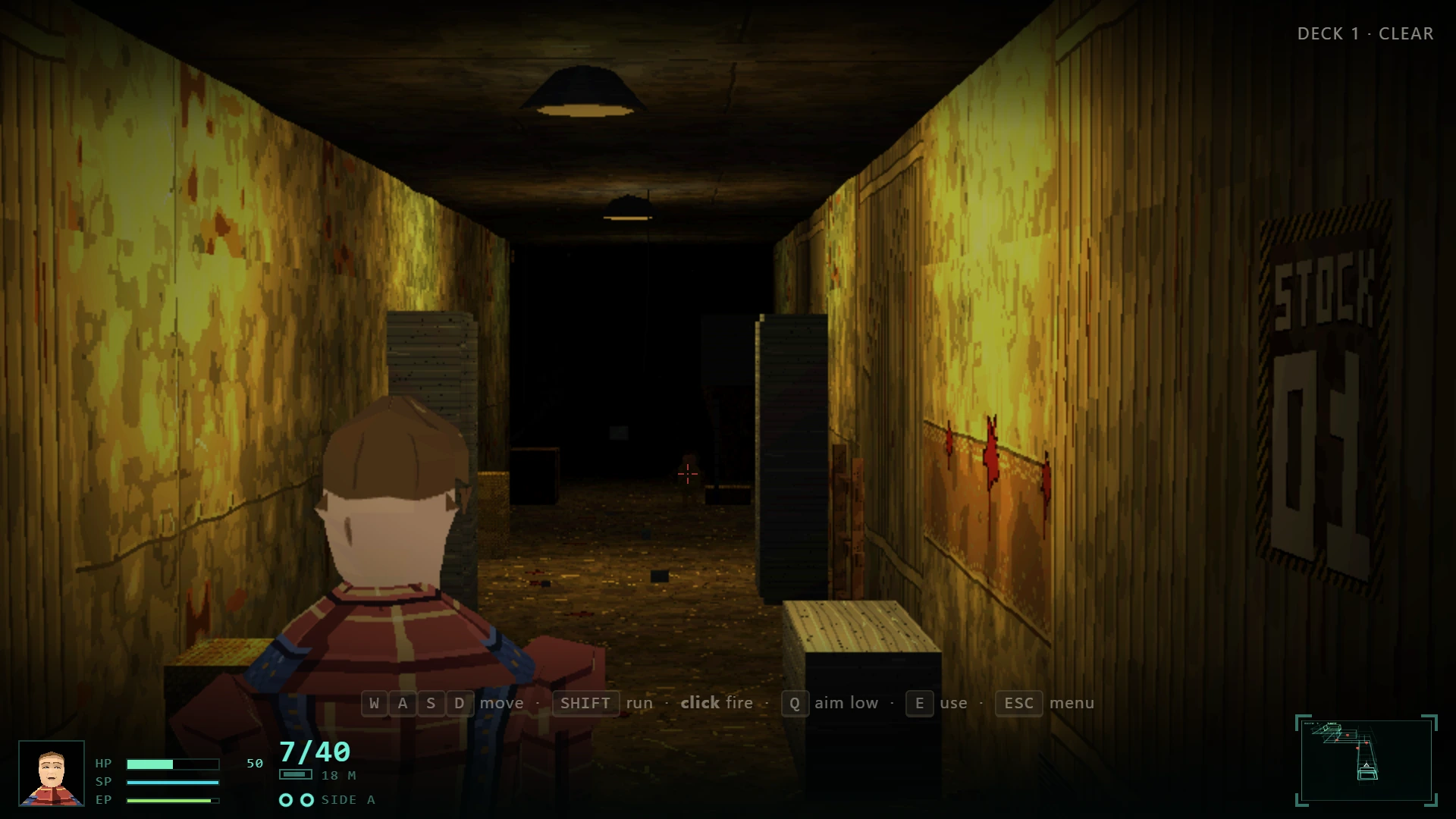
Third-person survival horror in PS1-era 3D. Earth is failing, so the Agency ships farmers and livestock to candidate worlds to find out whether life holds there. On Venus something airborne got into the animals. It does not affect humans at all, which is worse than if it did: Xander is not sick, he is food.
How it plays
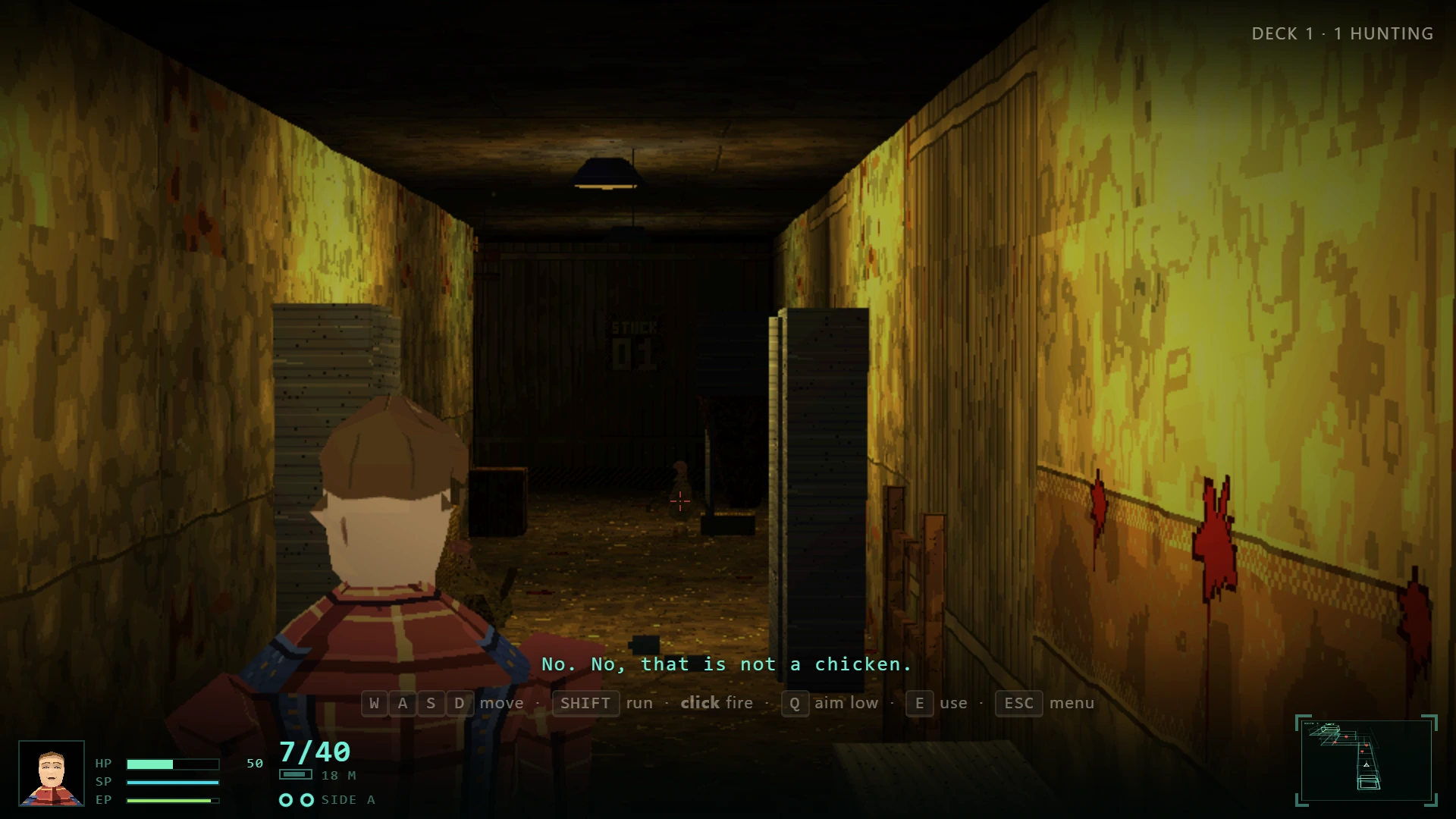
- Aim low. A mutated chicken bursts at 6.2 m/s and outruns your sprint. Take a leg off and it drops to 2.8 m/s and never catches you again. Emptying bolts into its body takes sixteen times as many.
- Shake it off. Anything that reaches you latches on, and your health drains faster the longer it holds. Alternate two keys, or hammer the button on a phone.
- The lift is the way out. Threats come from behind you and from the sides, never from the door — the corridor is an escape, not an arena.
- There is a cassette. Xander carries a walkman. It plays a D-dorian vamp, and it ducks when something is hunting you.
Made in the browser, for the browser
Every surface and every face in this game is generated at run time — there are no texture files to download. The sound is the one exception and it earns it: about 2.5 MB of real recorded effects and voice, fetched after the game is already playable, because synthesised horror sounds like a synthesiser. A link still opens into a playable game rather than into a download, and it runs on a phone.
Does it run on my machine?
If you can read this page you can play it. Evil Hills runs in the browser tab you already have open — there is nothing to install, no launcher, no account and no ads. It works on Windows, macOS, Linux, Android and iOS, in Chrome, Edge, Firefox and Safari, on a work laptop that will not let you install anything and on a phone on the bus.
Saving, and picking it up later
There is a pause screen — press Esc, or P, or just click away from the tab — and it has a save button on it. The save lives in your own browser, so closing the tab and coming back tomorrow puts you where you left off: the same deck, the same health, the same gun and the same ammunition.
If you make a free account on Magestican Studios, the save is copied to it as well. That is the part that matters if you play on a laptop at lunch and a phone in the evening, or if you are the sort of person who clears their browser and then regrets it. The game plays exactly the same either way — the account buys you the save surviving your browser, and nothing else.
How long is it?
Twelve decks, in three acts of four. Each act closes with a boss on its fourth deck, and the roster hardens as you go down: more of them behind you, the heavier things arriving earlier, and in the last act something waiting ahead of you as well as behind. A first run takes most people well under an hour; finishing it takes several, because you will die on the way and you will learn something each time.
Where the monsters come from
They come through the station, not out of thin air. Every corridor has feed ducts along the skirting and cracked pen-wall panels at chest height, and they are there from the moment you arrive — you walk past them long before any of them opens. When something does come through, it tells you first: the grille rattles, or the wall thuds from the inside, and only then does it give way in a shower of debris that stays on the floor for the rest of the deck. In the deepest act it can come through the ceiling.
Nothing teleports and nothing walks through a wall. If a chicken is coming for you it is coming along the corridor, which means the corridor's shape is something you can use.
Can I get away?
Yes, and that is deliberate. Anything chasing you tires: it accrues fatigue per metre of pursuit, not per second, so standing still does not wear it out — only running does. A chicken gives up after about sixty metres of chase, a porker takes twice that, and one that has quit stands in the corridor getting its breath back rather than despawning. You then have to decide whether to walk past it. Hiding in a locker, reaching the safe room and simply outrunning something are all real answers, which is why the game can afford to give you a gun that runs out of ammunition.
Is it actually scary?
It is trying to be, and it is trying to do it the way the games it comes from did: with a fixed camera that hangs off the corridor rather than off your shoulder, with darkness that hides the end of the hall, with sound that is almost entirely diegetic — a station announcer, an animal two rooms away, a walkman that ducks when something is hunting you — and with silence in between. There is blood and there is dismemberment. There is no gore for its own sake and nothing jumps at the camera to make you flinch.