Wordburrow — four free word games, big clear letters
Four word games on one page, with letters you can actually read and no clock anywhere near them.
The four games
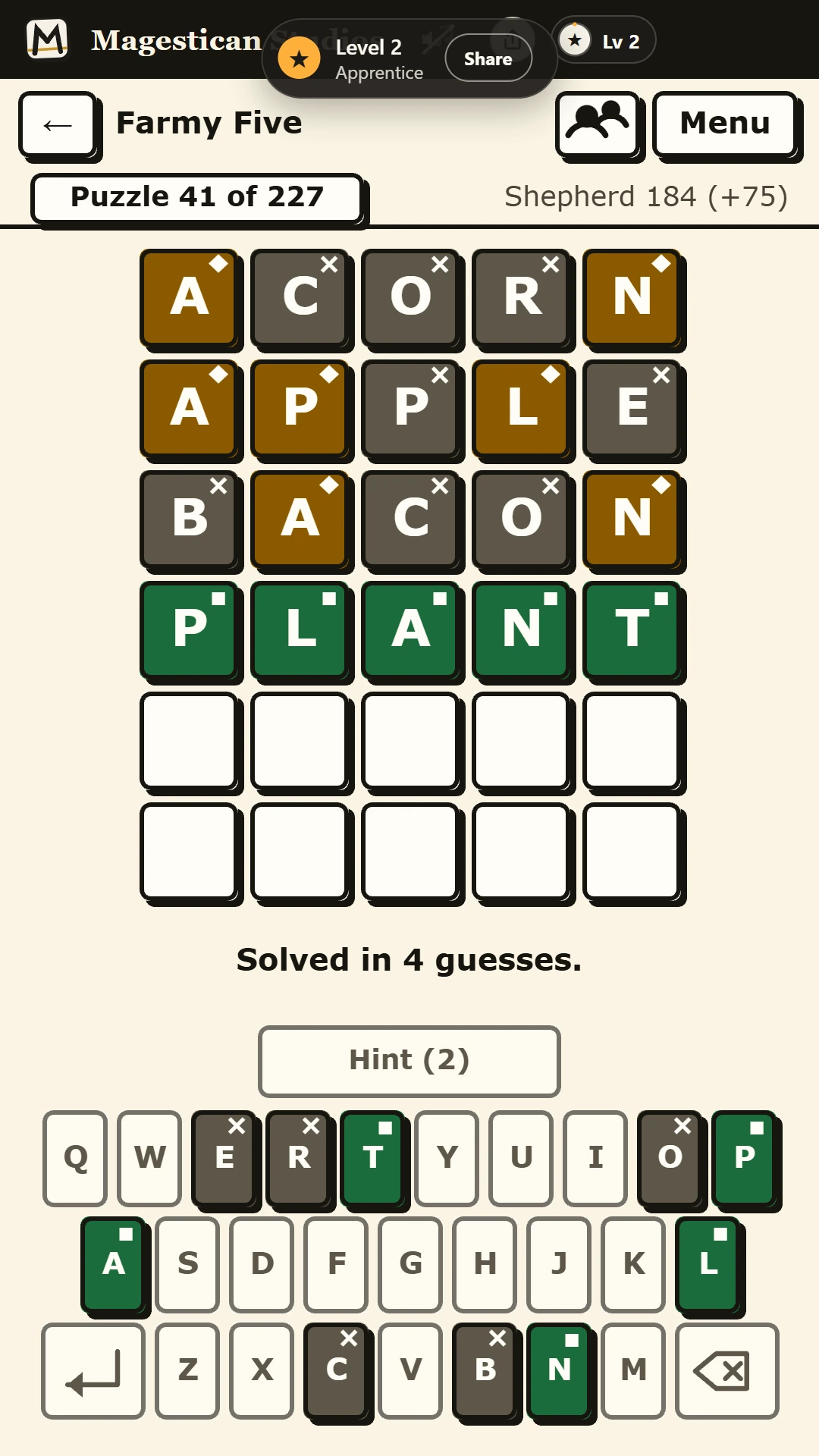
- Guesswise. Six guesses at a five-letter word. 227 words to work through, most of them off a farm.
- Combword. Seven letters, the middle one compulsory, four letters minimum. Fifty-three hives, each with its own answer list and its own pangram.
- Groupseek. Sixteen words, four secret groups of four, four mistakes. 90 sets, and a wrong guess holding three of one group is told so.
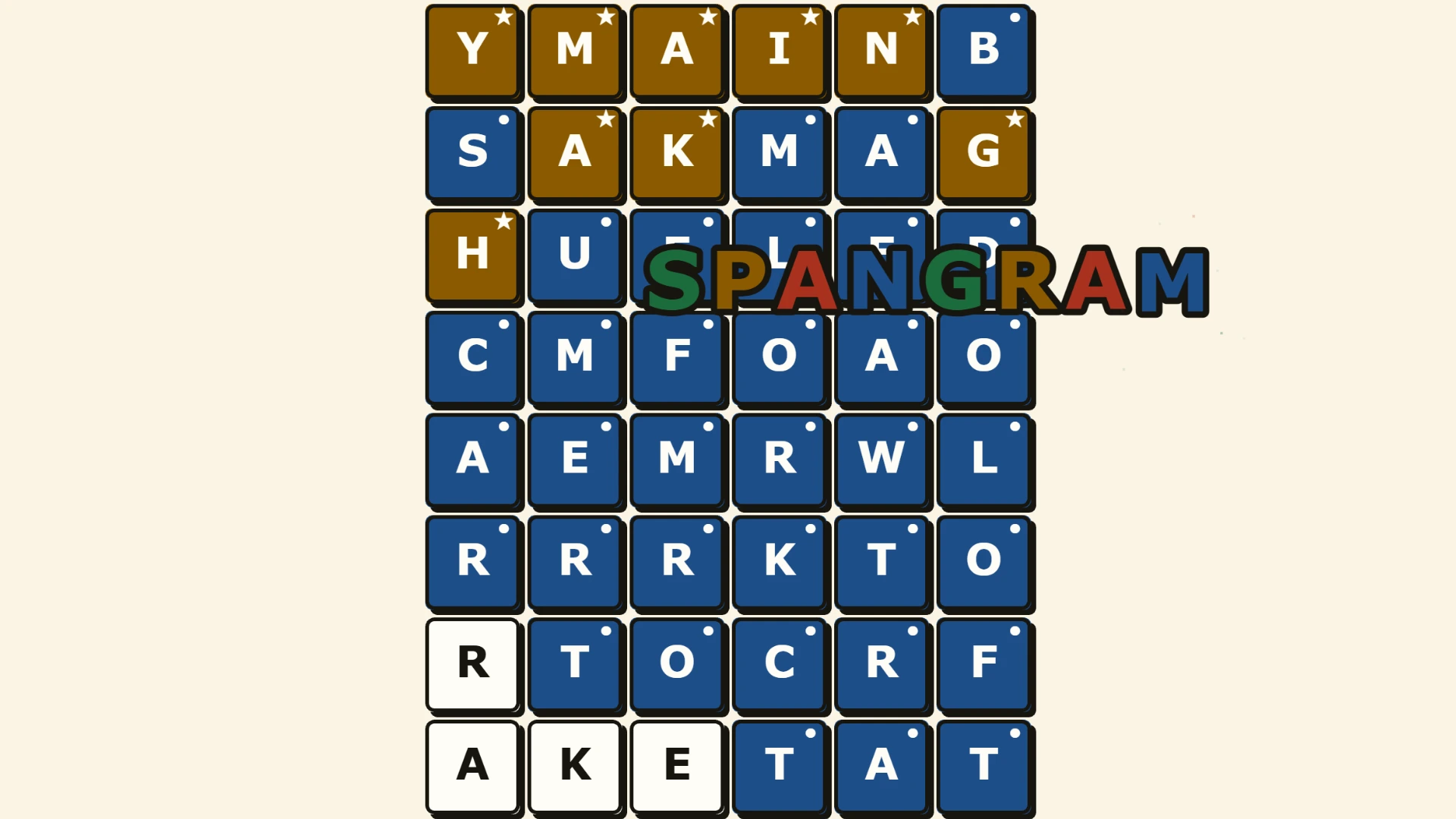
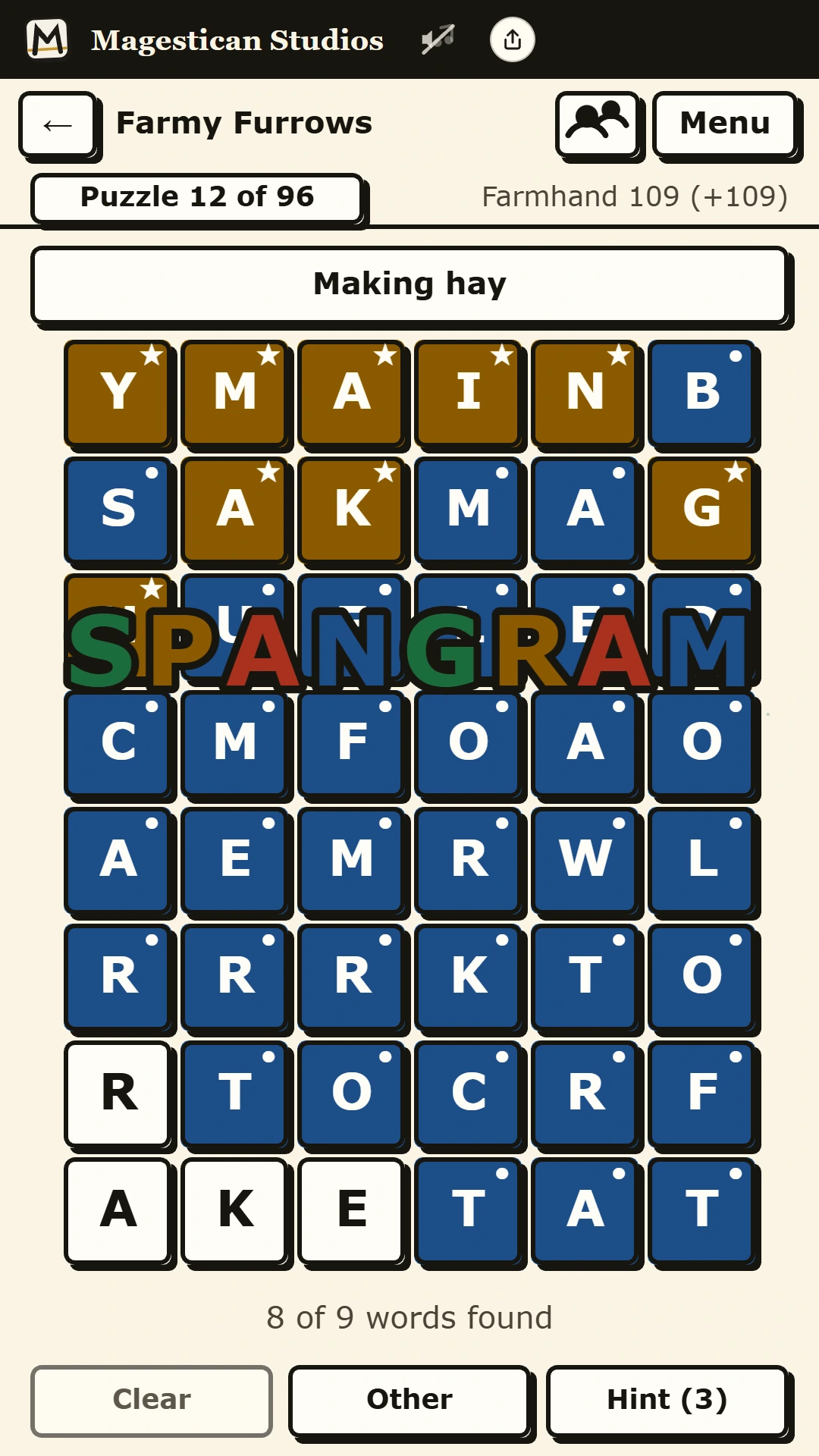
- Gridseek. A six-by-eight grid where every single letter belongs to a word about the day's theme, plus a spangram that names the theme and crosses the whole board. Ninety-six grids.
Each of the four has a page of its own, with its rules, its puzzle count and its own way in: Guesswise, Combword, Groupseek and Gridseek. Every one of them is the same page and the same room; the links simply open the game you came for instead of the menu.
You draw the words
The whole game is one drawn surface rather than a page of form controls, and it is built around the gesture each puzzle actually wants. In Strands, press and drag across letters that touch and a ribbon follows your hand - drag back over the last letter to rub it out, let go to submit. In the Combword, drag across the hive to spell. In Connections, sweep across four words in one movement. Nothing is only draggable: every word can be typed instead, and every board can be worked with the arrow keys.
You can type at any moment without clicking into anything. There is no text box to find and no "click here first". Type a letter at the menu and it opens Guesswise with that letter already in the first tile.
Play it with somebody
Press Play together and you get a room: the same puzzle, one shared board, and every word either of you finds appears on both screens. A grandparent and a grandchild on two sofas doing one Strands grid. Whatever you had already found comes with you into the room.
It is not a race, and that is deliberate. There is no clock anywhere in this game, so putting two people on a stopwatch would undo the one decision the rest of it is built around. You work the puzzle between you, at whatever speed you like.
There are two ways in and they are for two different conversations. Send somebody the link and it opens the room and the puzzle it was sent about. Or read out the six-character code - it has no O, I, L, S, Z, B, 0, 1 or 5 in it, precisely so it survives being said down a telephone and typed in by somebody at the other end. There is no account, no name to make up and no text box to find: type the code straight at the screen.
Built for eyes that are not twenty any more
This one was designed to a written brief before a line of it was built, and the brief is about the player rather than the decoration. Ageing eyes lose light and lose the ability to separate low-saturation hues; ageing hands miss small targets. So:
- Nothing is said with colour alone. Every coloured tile also carries a shape in its corner and a spoken label for a screen reader. A guessed row is green, gold and grey, which is three shades of one thing to about one man in twelve.
- Text clears AAA contrast, not AA. 7:1, not 4.5:1 - the difference between legible and comfortable.
- Nothing is smaller than 18 pixels and nothing you can press is smaller than 48 by 48. There is no small print, because there is nothing worth saying in small print.
- There is no timer. Not in any of the four games, and no streak that a slow week can break. A clock turns a puzzle into a test.
- Nothing moves unless you ask it to. Transitions are 120 milliseconds and are switched off entirely if your browser says you prefer reduced motion.
Every puzzle, today
There is a puzzle of the day in each game, and it rotates through the whole set - but nothing is locked and nothing expires. Every one of the two hundred and twenty-three playsets is in a dropdown on the same screen. A puzzle game that shows an older player one puzzle and then tells them to come back tomorrow has misread who is playing.
No account, no sign-in, nothing kept
Your progress lives in your own browser and goes nowhere else. There is no sign-in and no download, and playing on your own makes no network call at all once the page has loaded.
Playing together connects the two browsers directly to each other. The moves go peer to peer; there is no game server, nothing is stored, and the room stops existing the moment you close the tab.
Somebody played it on camera
Amelia, who fronts the studio's channel, plays these in one sitting and is not employed to be nice about them. She opens Guesswise with CRANE and the answer contains none of those letters, puts butter in the kitchen drawer, and is told by a farming game that FOWL is not a word. Watch it on YouTube →
The studio is building something even slower, too: Moon Life, a cozy farming game on a tiny moon, with jam, lamps and a cat for a landlord. It is in development and not playable yet.
More like this: 2-player games online · Multiplayer browser games · Free word games